

Fixation span in fracture fixation is the distance between the most widely separated fixation points within one main bone fragment. Increasing this span can improve mechanical leverage and distribute load across a broader fixation region. It differs from plate working length: the distance between the innermost screws on opposite sides of the fracture. A longer fixation span and an appropriate working length serve different purposes; neither should be maximized without considering the fracture and implant.
This educational overview explains the distinction using plates, intramedullary nails, external fixators, and cortical screw engagement. It draws on Rockwood and Green’s Fractures in Adults, 10th edition, with supporting references below. It is intended for orthopedic professionals and does not replace patient-specific planning or the implant’s instructions for use.
On this page: Definition · Fixation span vs working length · Plates and screws · Intramedullary nails · External fixation · Cortical engagement · FAQs
What is fixation span, and why does it matter?
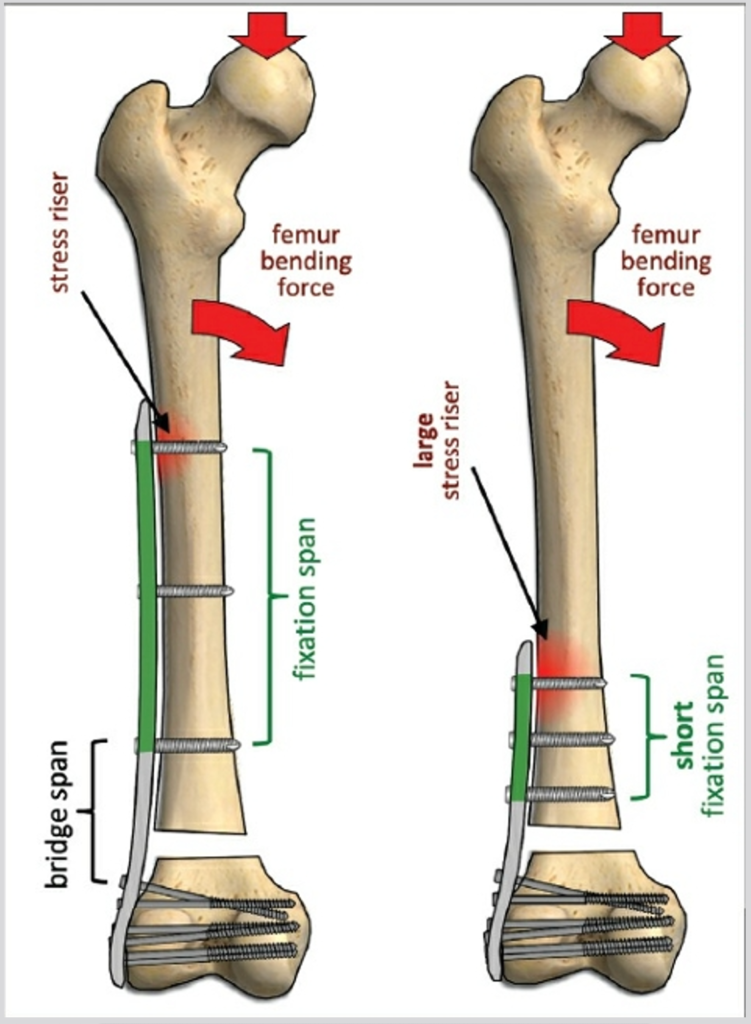
For a plate attached to one main fragment, fixation span describes the distribution of the outermost and innermost fixation points within that fragment. A wider distribution gives the construct a broader support base to resist the bending moment transferred through the bone and implant. This can reduce the demand concentrated at an individual screw–bone interface.
The standing-on-a-moving-bus analogy is useful: spreading the feet creates a wider support base. However, the analogy does not predict a clinical outcome. Bone quality, screw purchase, loading direction, fracture contact, and implant design still determine how the construct behaves.
Fixation span vs working length: what is the difference?
These measurements describe different parts of the construct. In this article, working length refers specifically to the plate segment between the screws nearest the fracture on opposing fragments. “Bridge span” is often used in that sense, but terminology can vary between sources and implant systems. Always check the endpoints being measured.
| Parameter | What is measured? | Why it matters |
|---|---|---|
| Fixation span | Maximum separation of fixation points within one main fragment | Describes how widely fixation is distributed in that fragment |
| Plate working length / bridge span | Distance between the innermost screws across the fracture | Influences deformation of the plate bridge and fracture-site motion |
| Plate length | Overall implant length | Provides available space for bridging and fixation; does not specify screw placement |
| Screw density | Proportion of plate holes occupied by screws | Describes screw occupancy, not their distribution or purchase |
For example, removing the screw closest to the fracture increases the working length if the next screw becomes the new innermost fixation point. With the outermost screw unchanged, it also reduces the fixation span on that side. Conversely, extending a plate and moving an outer screw farther along the fragment can increase fixation span while leaving working length unchanged.
The AO Surgery Reference discussion of forearm bridge plating defines working length using the inboard screws and describes the tradeoff between excessive motion and implant fatigue. Its procedure-specific screw recommendations should not be applied to every bone or fracture pattern.
How do plate length and screw distribution affect fixation?
In the distal femoral example, the plate must resist bending transferred from the proximal femur. A longer plate with screws distributed over a larger shaft segment can provide better leverage than a short plate with clustered screws. The important comparison is the fixation geometry under otherwise comparable conditions, rather than plate length alone.
Screw count cannot describe that geometry. Two constructs with the same number of screws may have different fixation spans, working lengths, and mechanical behavior. Empty holes may be intentional in bridge plating, but adequate fixation in each main fragment remains essential. Poor bone purchase or a short periarticular fragment can change the requirements.
The textbook discussion describes diminishing returns from adding diaphyseal screws in the constructs discussed. Those observations are not a universal three- or four-screw rule. Implant-specific requirements, bone quality, fracture location, and the intended loading environment take priority over a general numerical threshold.
Does a longer working length always improve stability?
No. Working length affects how the plate deforms, while fracture contact and loading direction affect the resulting motion. A 2025 biomechanical study of synthetic distal femur constructs examined working length, screw number, fracture morphology, and gap conditions under axial and torsional loading. Its findings reinforce the need to interpret screw changes together with fracture geometry. Laboratory construct behavior does not establish a universal clinical screw layout.
Strength, stiffness, and durability also need separate consideration. Strength concerns the load a construct can withstand before failure; stiffness is its resistance to deformation; fatigue resistance concerns repeated loading. The intended healing strategy determines the mechanical environment required. Greater rigidity alone does not establish that a construct is suitable.
Why are short distal segments challenging for intramedullary nails?
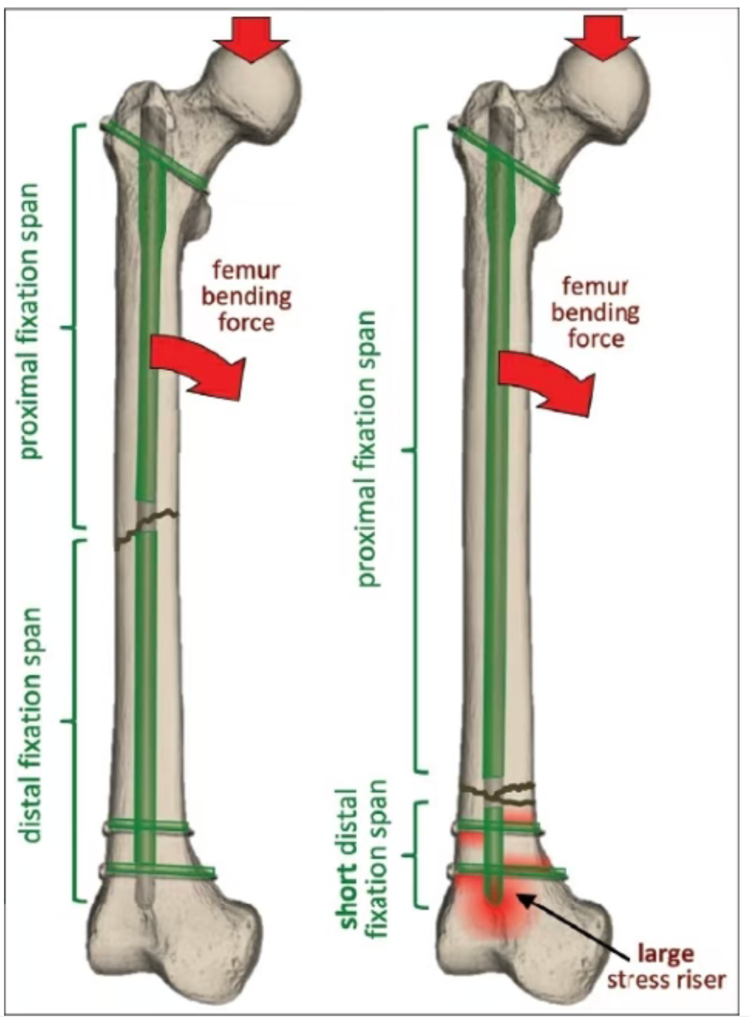
An intramedullary nail lies closer to the bone’s central axis than a lateral plate, but secure fixation of each main fragment remains necessary. In a short distal segment, limited space for interlocking fixation and a wider metaphyseal canal can make alignment and stability more demanding, particularly when the fracture does not share load.
The nail diagram illustrates that geometric limitation; it does not mean that distal fractures are unsuitable for nailing. Nail fit, interlocking options, fragment length, and reduction all matter. AO’s distal-third femoral nailing reference discusses locking and the role of blocking screws in selected patterns. These are case-dependent techniques, not additions required for every construct.
How does pin spacing affect external fixator stability?
For an external fixator, pin or pin-group distribution within each main fragment provides an analogous support span. AO’s modular external fixation guidance recommends separating pins within each main fragment while respecting the fracture zone and injured soft tissues. Frame stiffness also depends on pin dimensions, rod-to-bone distance, and connecting-rod configuration.
Wider spacing is therefore one design variable. Safe anatomical corridors, soft-tissue clearance, and any planned definitive fixation constrain where pins can be placed. Circular-frame behavior likewise depends on the complete ring, wire, and pin configuration, rather than spacing alone.
How does bicortical engagement change screw support?
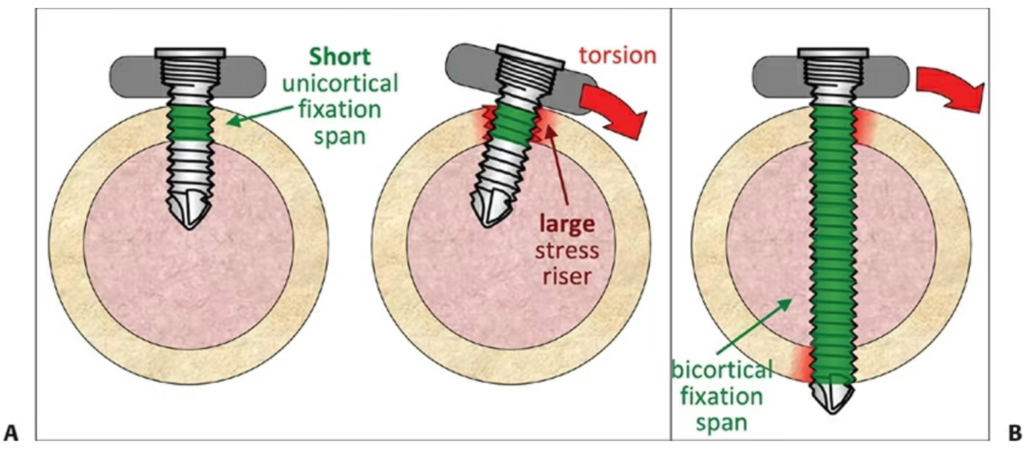
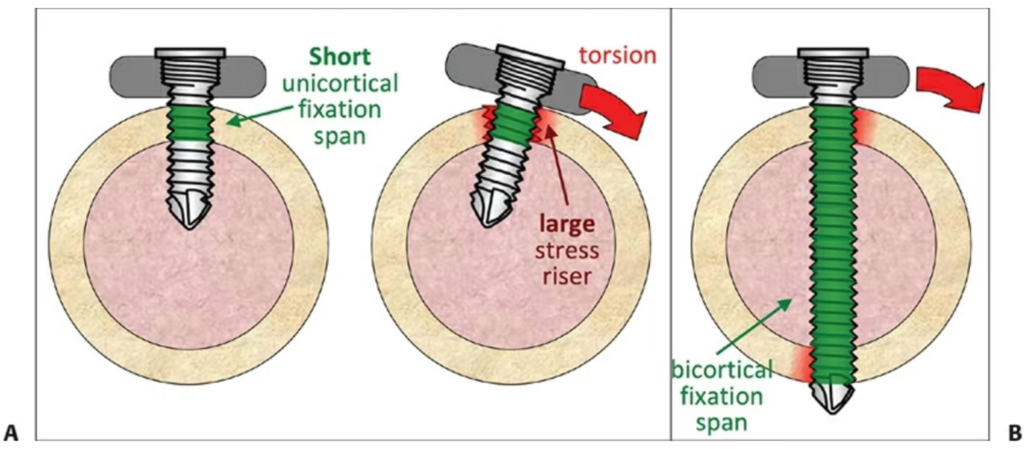
A unicortical screw engages one cortex; a bicortical screw engages both. The textbook discussion uses this wider support distance to explain improved resistance to screw toggle under torsion in the constructs discussed. That screw-level use of “working length” should be distinguished from the plate-level definition above.
The effect is not a blanket preference for bicortical fixation. Locking versus nonlocking screws, cortical thickness, implant design, and nearby anatomical structures affect the choice. A percentage improvement from one experimental configuration should not be presented as the expected benefit in all patients or implants.
What should a fixation construct assessment consider?
- Healing objective: establish the required stability and intended healing mechanism.
- Fracture geometry: consider fragment length, comminution, alignment, and potential bone contact.
- Fixation in each fragment: assess distribution and purchase separately from the bridge across the fracture.
- Loading and transitions: consider bending, torsion, repeated loading, and areas where load or stiffness changes abruptly.
- Biology and anatomy: preserve the soft-tissue environment and respect safe fixation corridors.
- Device guidance: use the implant-specific technique and instructions rather than a universal screw count or spacing formula.
Frequently asked questions about fixation span
Is fixation span the same as plate length?
No. Plate length describes the entire implant. Fixation span describes how far apart the fixation points are within a particular bone fragment. A long plate with clustered screws may still have a short fixation span.
Is fixation span the same as working length?
No. In bridge plating, fixation span is measured within a fragment, whereas plate working length is measured across the fracture between the innermost screws. A change in screw position can increase one while reducing the other.
Does increasing fixation span always prevent implant failure?
No. Wider fixation can improve leverage, but it cannot compensate for inadequate purchase, unsuitable reduction, unfavorable loading, or delayed healing. It is one component of a complete fixation strategy.
Should every plate hole contain a screw?
Not necessarily. Screw placement depends on the fixation method, fracture pattern, and implant. The aim is adequate fixation and the intended mechanical behavior; neither filling every hole nor using the fewest screws is a universal rule.
Key takeaway
Fixation span concerns the support available within a fragment; plate working length concerns the bridge across the fracture. Assess both together with bone quality, screw purchase, fracture contact, and the intended healing strategy. The goal is a construct that provides suitable stiffness while maintaining strength and durability.
For further reading, visit our orthopedic articles. For implant-system information, see the Youbest orthopedic product overview and request the relevant product documentation.
Sources and evidence
- Rockwood and Green’s Fractures in Adults, 10th edition. Discussion of fixation span and construct configuration.
- AO Surgery Reference: ORIF – Bridge plating of multifragmentary forearm fractures.
- AO Surgery Reference: Modular external fixation.
- AO Surgery Reference: Retrograde nailing for distal-third femoral shaft fractures.
- Influence of fracture morphology and working length on shear motion and construct stiffness in osteosynthesis constructs (2025). Biomechanical model study.