

Meta Description:
Discover why trauma implants are the fastest growing segment in orthopedics, driven by rising injuries, aging populations, and expanding global trauma care systems.
The Brutal Reality Behind Why Trauma Implants Are the Fastest Growing Segment
Let’s start with an uncomfortable truth.
The growth of the orthopedic industry is not driven by innovation alone.
It’s driven by injury.
Every day, millions of people suffer fractures caused by traffic accidents, falls, and high-impact trauma. According to the World Health Organization, road traffic injuries alone cause over 1.19 million deaths annually, with tens of millions more requiring surgical care.
This is the core reason why trauma implants are the fastest growing segment.
Not because surgeons prefer them.
Not because companies promote them.
But because the world is becoming more dangerous—and more mobile.
Urbanization increases risk.
Motorization accelerates injury rates.
Aging populations weaken bone quality.
Together, these forces create a perfect storm.
And trauma implants sit at the center of it.
Trauma Surgery Demand Is Exploding Globally
To understand why trauma implants are the fastest growing segment, you need to look beyond developed markets.
The real surge is happening in:
- Southeast Asia
- Latin America
- Africa
Hospitals in these regions are rapidly expanding trauma care capacity.
More operating rooms.
More trained surgeons.
More surgical procedures.
This leads directly to increased demand for:
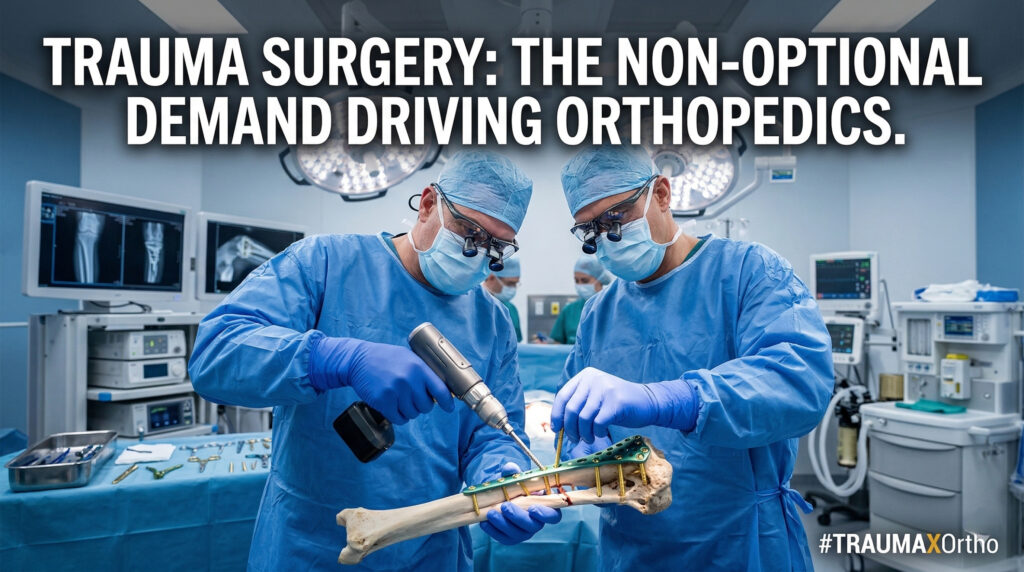
- plates and screws systems
- intramedullary nails
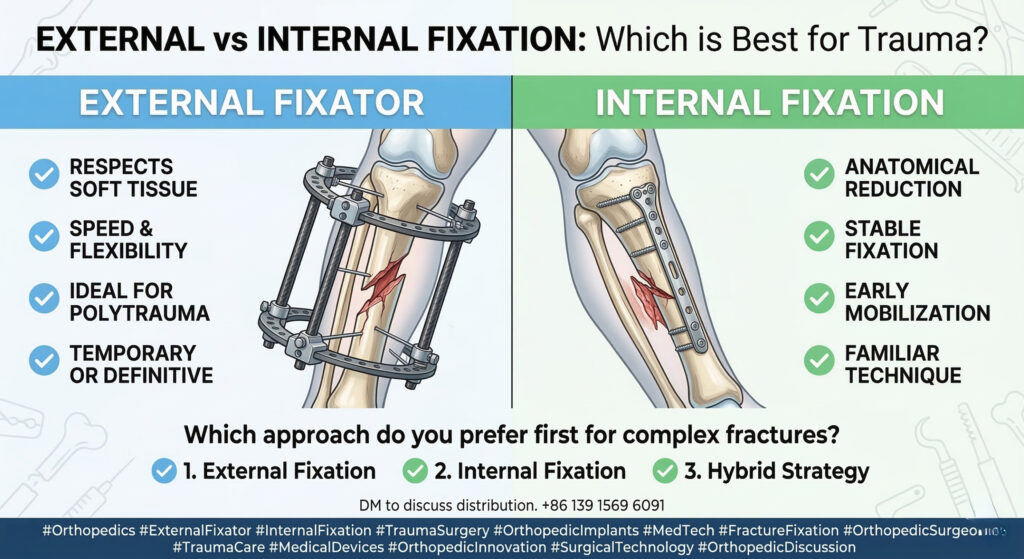
- external fixation systems
In many countries, trauma surgery is transitioning from conservative treatment to surgical fixation.
That shift alone explains a large part of why trauma implants are the fastest growing segment in orthopedics.
Trauma Implants Solve Immediate, Life-Critical Problems
Unlike elective procedures, trauma surgery cannot wait.
This is a critical distinction.
When analyzing why trauma implants are the fastest growing segment, urgency plays a massive role.
Trauma implants are used in:
- emergency fracture stabilization
- life-saving surgeries
- damage control orthopedics
In these situations, the decision is not optional.
It is immediate.
This urgency creates a consistent, non-cyclical demand.
While joint replacement markets may fluctuate, trauma implants remain stable—and growing.
Because trauma does not depend on economic cycles.
It depends on reality.
And reality is unpredictable.
Aging Populations Are Accelerating Trauma Implant Demand
Another major driver behind why trauma implants are the fastest growing segment is demographic change.
The global population is aging.
And aging bones break more easily.
Hip fractures, distal radius fractures, and vertebral injuries are increasing rapidly worldwide.
Elderly patients require surgical fixation to restore mobility and reduce complications.
This creates sustained demand for trauma implants, including:
- locking plates for osteoporotic bone
- intramedullary nails for long bone fractures
- minimally invasive fixation systems
The combination of aging populations and increased life expectancy ensures that trauma implants are the fastest growing segment for years to come.
Technological Evolution Is Reinforcing Market Growth
Trauma implants are no longer basic metal devices.
Modern systems are becoming smarter, lighter, and more adaptable.
Innovations include:
- carbon fiber materials for better imaging
- modular fixation systems for flexibility
- minimally invasive surgical techniques
These improvements make trauma implants more effective and easier to use.
They also expand their clinical applications.
As technology evolves, it further reinforces why trauma implants are the fastest growing segment in the orthopedic market.
Better tools lead to more surgeries.
More surgeries lead to higher demand.
The Strategic Opportunity for Distributors and Manufacturers
For companies in the orthopedic industry, this trend is impossible to ignore.
Understanding why trauma implants are the fastest growing segment reveals a massive opportunity.
Distributors and manufacturers that focus on trauma portfolios can benefit from:
- consistent demand
- global market expansion
- lower dependency on elective procedures
However, success requires more than products.
It requires:
- surgeon training
- reliable supply chains
- adaptable product systems
Those who deliver complete solutions—not just implants—will dominate this segment.
The Future of Orthopedics Is Being Defined by Trauma
Here’s the bottom line.
The orthopedic industry is evolving.
But not in the way many expected.
It’s not just about robotics.
It’s not just about joint replacement.
It’s about trauma.
The reason why trauma implants are the fastest growing segment is simple:
They solve urgent, unavoidable problems.
And those problems are increasing.
The future of orthopedics will not be shaped only by innovation.
It will be shaped by necessity.
💬 Let’s ask the industry:
Do you believe trauma implants will continue to dominate orthopedic growth in the next decade?
More info. https://linktr.ee/shifreeman
#Orthopedics #TraumaImplants #TraumaSurgery #OrthopedicImplants #MedicalDevices #FractureFixation #HealthcareInnovation #OrthopedicMarket #MedTech