

What determines humerus fracture treatment?
Humerus fracture treatment depends on where the upper arm bone breaks, how far the pieces have moved, and whether the nerves, blood vessels, or skin are injured. Some breaks can heal with a sling or brace. Others need surgery to restore shape and hold the fragments while they heal. Start with the fracture, not the hardware. The bone spans the shoulder, upper arm, and elbow. Each region needs its own plan. A neat X-ray is only part of the goal. A useful arm, safe motion, and sound healing matter as well. This guide focuses on adult fractures and the decisions behind bracing, plates, and nails. It explains the tradeoffs to discuss with a trauma team; it cannot choose a procedure from an image alone.
Does a break near the shoulder always need surgery?
No. Many proximal humerus fractures, especially those with little displacement, can be managed without an operation. The shoulder still needs a plan for support, review, and safe movement. Humerus fracture treatment should not default to surgery simply because the patient is older or the scan looks dramatic. The PROFHER randomized trial found no significant overall advantage for surgery in the displaced surgical-neck fractures it studied. That result has limits. It does not settle care for every fracture-dislocation, humeral head split, or urgent nerve or blood vessel problem. The surgeon must assess the pattern, bone quality, prior function, and the patient’s goals. Ask what benefit an operation is expected to add in this specific case. Then ask what risks come with it. The decision deserves more than a reflex answer.
Why can proximal fixation lose its hold?
A plate alone cannot make up for poor bone position. In a break near the shoulder, the shape of the head, support on the inner side of the bone, and screw position all affect the repair. Weak bone and multiple fragments can make that task harder. Collapse may change the position of screws relative to the joint. Humerus fracture treatment therefore needs a plan for both alignment and support, not just a choice of implant brand. Selected cases may need added support, but more material is not automatically better. The supplied review describes mixed findings for augmentation methods. Do not turn a biomechanical advantage into a guaranteed clinical result. Ask how the construct will hold the reduced fragments and how the team will check it over time. Follow-up matters because a repair that looks sound at first can still change under load.
When can a shaft fracture heal in a brace?
A functional brace can be an option for selected humeral shaft fractures when alignment is acceptable and the patient can manage the brace and attend follow-up. Choosing it is active care. Fit, skin checks, repeat images, and a clear response to stalled healing are part of the job. Humerus fracture treatment may shift toward surgery when the injury is open, blood flow is threatened, the pattern is unstable, or other injuries make bracing unsuitable. The person’s work, daily needs, and ability to follow the plan also matter. Surgery brings its own risks, including infection and nerve injury. A brace can bring discomfort, stiffness, and failure to unite. Ask how those risks compare for this fracture. The right discussion is about the whole recovery path, not just avoiding an operation today.
Plate, MIPO, or nail: what actually changes?
For a shaft fracture, a plate holds the bone from the outside, while an intramedullary nail sits within the canal. Open plating allows direct access to the fracture. Minimally invasive plate osteosynthesis, or MIPO, uses smaller access points to limit exposure of the fracture zone. Each method trades access against risks to nearby tissue. Humerus fracture treatment should account for the fracture level, fragment size, bone quality, and the surgeon’s experience. A nail’s entry route can affect the shoulder or elbow. A plate requires careful protection of the radial nerve. Smaller incisions do not remove those risks. Ask why the proposed method suits the pattern and how alignment will be checked. A useful answer should connect the technique to a specific problem. Naming a device is not the same as explaining a plan.
Does radial nerve palsy always need exploration?
Weak wrist or finger extension after a shaft fracture can signal a radial nerve injury. Timing matters. Weakness at the time of injury differs from a new loss of strength after the bone is moved or fixed. Humerus fracture treatment must include a clear record of the nerve exam and a plan to track recovery. The AO Surgery Reference explains why many radial nerve lesions recover without an operation, while suspected disruption changes the decision. An open wound, associated vessel injury, possible entrapment, or a new deficit can prompt a different approach. Watching the nerve means checking it at planned visits. It does not mean doing nothing. Tests such as ultrasound or nerve studies may help in selected cases. Ask what findings would trigger further investigation or exploration. New loss of hand function needs prompt clinical assessment; do not wait for a routine appointment to report it.
Why is a fracture near the elbow different?
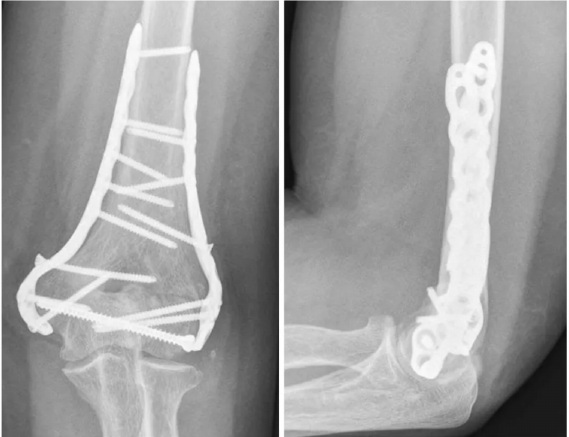
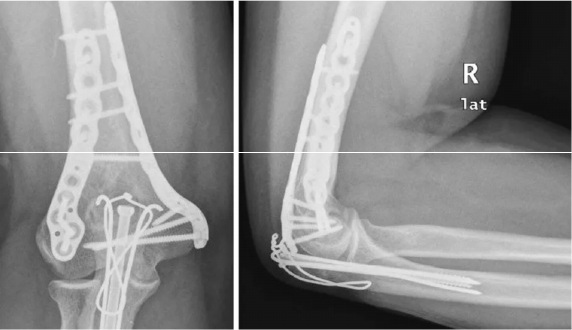
A distal humerus fracture may split the joint surface as well as the columns that support it. That creates two linked tasks. Restore the joint shape. Then build a sound repair that allows safe motion. Humerus fracture treatment near the elbow often requires surgery, although the decision still depends on displacement, bone quality, health, and daily needs. The AAOS guide to distal humerus fractures explains the role of fixation and the risk of stiffness. Leaving the elbow still for too long can cost motion, yet moving beyond the repair’s limits can also cause harm. The team must set the pace. Ask how the fragments will be held and when motion can begin. The X-rays below illustrate fixation patterns from the source article; they do not establish that one plan fits all elbows.
Parallel or orthogonal plates: avoid the universal winner claim
Parallel plating places plates on the inner and outer columns. An orthogonal construct commonly combines a medial plate with a posterolateral plate in a roughly right-angle arrangement. Both aim to secure the joint block to the shaft. Humerus fracture treatment should match screw paths and plate position to the fragments available for fixation. Some studies favor parallel constructs for particular mechanical measures, but that does not prove better results in every patient. Bone quality, fracture lines, reduction, and the stability actually achieved still matter. The source images show examples, not a controlled comparison. Nerve handling needs the same care: routine movement of the ulnar nerve is not a universal requirement. Its position, tension, and contact with implants should guide the decision. The goal is a stable elbow with protected nerves, not loyalty to one plate layout.
What should a useful recovery plan include?
A good plan names the next steps. It also says why they matter. Humerus fracture treatment should include clear advice on arm support, wound or skin care, safe motion, lifting limits, and review dates. There is no single healing deadline for all three regions of this bone. Ask what progress the team expects on repeat images and in daily function. Keep a brief recovrey log of pain, swelling, and movement to discuss at visits. Seek urgent care for a cold or pale hand, a new loss of feeling or movement, or rapidly worsening pain. After surgery, drainage, spreading redness, or fever also need prompt review. Do not add weight just because the arm feels better. Use the questions below to turn a vague instruction to “take it easy” into a plan you can follow.
- Where is the break, and does it involve a joint?
- What makes a sling, brace, plate, or nail suitable here?
- Which movements and loads are safe before the next review?
- What findings would change the plan?
Sources and further reading
- Source review and radiographs: 关于肱骨骨折,你需要知道的11个问题, 骨今中外. The illustrations show distal humeral fixation, not every type of humerus fracture.
- Evidence links: PROFHER randomized trial, AO Surgery Reference, and AAOS OrthoInfo, linked in the relevant sections above.
- Explore more fracture care articles from Youbest.
- Educational overview for adults; a qualified clinician must assess the injury and set the treatment plan.