

Meta Description:
Discover why the femur is the strongest bone in the human body, how its structure supports extreme loads, and why this matters for orthopedic trauma and implant design.
The Biomechanics Behind Why the Femur Is the Strongest Bone
The femur, or thigh bone, is widely recognized as the strongest bone in the human body. Understanding why the femur is the strongest bone reveals a fascinating mix of anatomy, biomechanics, and evolutionary design.
The femur must carry enormous loads every day.
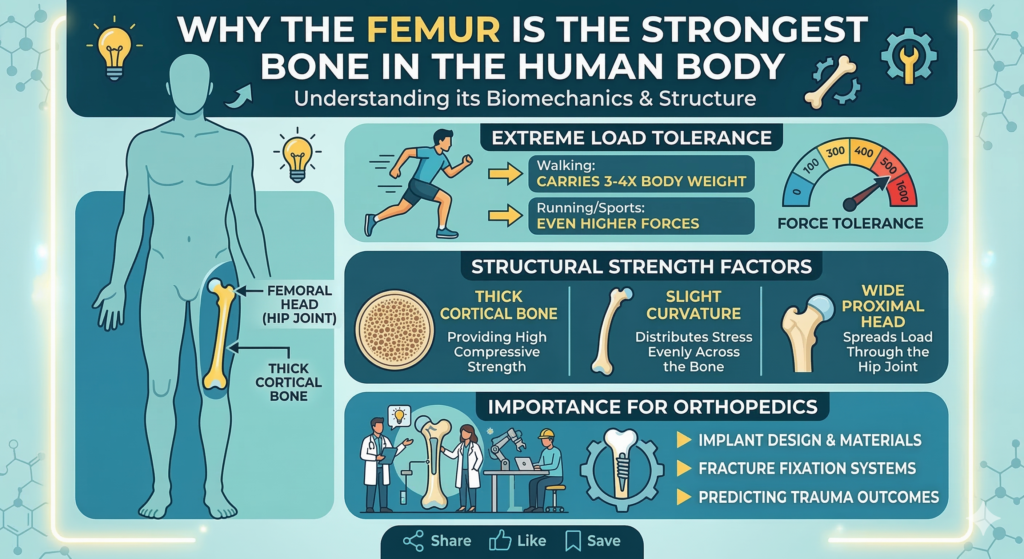
Walking, running, or simply standing transfers body weight through this bone. Studies show that the femur can tolerate forces up to 3–4 times body weight during normal walking and much higher during sports.
Several structural factors explain why the femur is the strongest bone:
- Thick cortical bone for compressive strength
- Slight curvature that distributes stress
- A wide proximal head that spreads load through the hip joint
These features allow the femur to withstand extreme mechanical stress without failing.
For orthopedic surgeons and engineers, understanding why the femur is the strongest bone is critical when designing implants and fracture fixation systems.