

Meta Description:
Explore Ilizarov external fixation practical techniques, including component principles, ring-wire-hinge systems, and advanced applications. Learn how global evolution reshaped modern orthopedic reconstruction.
Ilizarov External Fixation Practical Details: It’s Not About Hardware—It’s About Thinking
Most surgeons assume the Ilizarov external fixation system is complicated because of its hundreds of components.
That’s wrong.
The real complexity lies in understanding the mechanics and biology behind it.
At its core, Ilizarov external fixation practical details are not about assembling rings and wires. They are about controlling force, alignment, and biological response.
According to the AO Foundation, modern fracture treatment must balance stability with biological preservation. Ilizarov achieved this decades ago.
What you see:
- Rings
- K-wires
- Hinges
- Rods
What truly matters:
👉 Tension accuracy
👉 Mechanical axis control
👉 Structural harmony
That’s why some surgeons achieve remarkable regeneration… while others struggle with failure.
Component Logic: Why Hundreds of Parts Exist in Ilizarov Systems
Why does Ilizarov external fixation practical details involve so many components?
Because no fracture is standard. And no patient is identical.
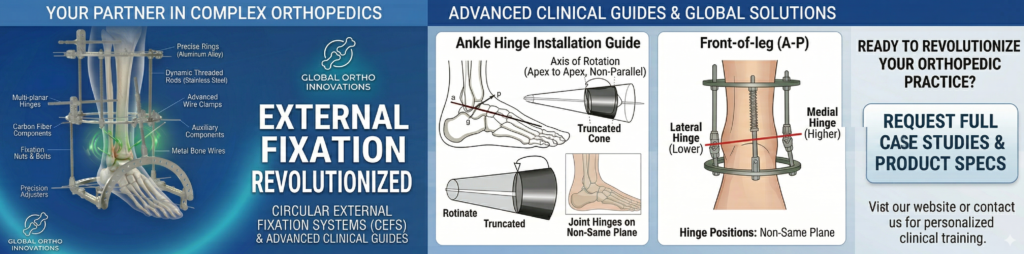
Core components explained:
- Rings (Circular frames) → Define spatial stability and load distribution
- K-wires (Kirschner wires) → Convert tension into dynamic stability
- Hinges → Enable controlled angular correction
- Connecting rods → Transfer forces across the construct
👉 The key insight:
Great surgeons don’t use more components.
They use precisely what is needed.
Overbuilding a frame increases complexity—and amplifies error.
This is where most failures begin:
Not lack of tools, but lack of system design thinking.
Russia vs Europe vs China: How Ilizarov Evolved Globally
To understand Ilizarov external fixation practical details, you must understand its evolution.
🇷🇺 Russian (Kurgan origin)
- Pure Ilizarov philosophy
- High reliance on wire tension and biology
- Classic circular constructs
👉 Strength: theoretical precision
👉 Limitation: steep learning curve
🇪🇺 European/Western adaptation
- Introduction of hybrid and mono-lateral systems
- Focus on simplicity and surgical efficiency
👉 Strength: easier adoption
👉 Limitation: reduced flexibility
🇨🇳 Chinese innovation
- Integration of Ilizarov + AO principles
- Minimally invasive techniques + hybrid constructs
- Strong emphasis on clinical practicality
Key advancements include:
- Tibial transverse transport
- Advanced foot & ankle correction frames
- Micro-incision reconstruction techniques
👉 Conclusion:
Ilizarov external fixation practical details have been transformed into scalable clinical solutions in China.
Ring Assembly & Wire Placement: The Details That Decide Outcomes
Most complications are not conceptual—they are technical.
🔥 Critical principles:
✔ K-wires must be properly tensioned—not just inserted
✔ Ring placement must follow mechanical axis—not convenience
✔ Safe corridors must be respected
❌ Common mistakes:
- Incorrect wire angles → increased shear forces
- Off-center ring positioning → instability
- Insufficient tension → uncontrolled micromotion
👉 The truth:
Ilizarov is not rigid fixation—it is controlled micromotion.
Miss that, and everything fails.
Distraction, Compression, Correction: Where Real Mastery Begins
This is the essence of Ilizarov external fixation practical details.
You are not just fixing bone.
You are guiding biological regeneration.
Three core mechanisms:
- Distraction → Bone regeneration and lengthening
- Compression → Enhancing fracture healing
- Correction → Gradual deformity alignment
👉 The real challenge is timing:
- How many millimeters per day?
- How many adjustments?
- When to stop?
Get the rhythm wrong, and outcomes collapse.
Precision is everything.
Tibial Transport & Foot Correction: Why Chinese Techniques Are Rising Fast
Today, the most talked-about aspect of Ilizarov external fixation practical details is not traditional bone lengthening.
It’s:
👉 Tibial Transverse Transport (TTT)
Used for:
- Diabetic foot
- Chronic ischemia
- Non-healing wounds
At the same time, Chinese surgeons have advanced foot and ankle deformity correction using:
- Multi-ring configurations
- Precision hinge alignment
- Patient-specific constructs
👉 Result:
Cases once requiring internal fixation can now be managed externally.
This isn’t improvement.
It’s a paradigm shift.
The Philosophy: Without It, Technique Fails
Many surgeons ask:
“Why can’t I get consistent results with Ilizarov?”
Because they learn the device—
but not the philosophy.
The foundation of Ilizarov external fixation practical details is simple:
- Bone regenerates under controlled stress
- Blood supply is everything
- Stability is dynamic—not absolute
Without this understanding, surgeons tend to:
- Over-stabilize
- Over-complicate
- Over-intervene
And ultimately fail.
Final Thought: Mastery Lies Beyond the Frame
Ilizarov is not just a fixation method.
It’s a system.
A language of force, biology, and time.
So ask yourself:
Are you building frames?
Or designing outcomes?
More info. https://linktr.ee/shifreeman