
For many medical device distributors, the biggest sourcing question is no longer only “Can I get this product at a good price?”
The better question is:
“Can I build a reliable orthopedic product supply chain that survives real market pressure?”
This is especially important in emerging markets across South America, Latin America, Africa, the Middle East, and parts of Asia. Demand for orthopedic implants and surgical instruments is growing, but the operating environment is not always easy. Import procedures can be slow. Hospital budgets can change. Currency pressure can affect purchasing plans. Shipping schedules can move. Documentation requirements can become more demanding. Local competition can be intense.
In this environment, orthopedic implant sourcing must become more strategic.
The Industry Phenomenon: Distributors Need More Control
Orthopedic distributors used to focus heavily on product catalog and price list. Today, that is not enough.
A distributor may need to manage:
- Trauma implant SKUs for plates, screws, nails, and instruments.
- Hospital evaluation samples.
- OEM packaging and local-language labeling.
- Tender preparation documents.
- Small orders for surgeon feedback.
- Repeat orders for fast-moving products.
- Inventory risk when demand is uncertain.
- After-sales support when instruments or product codes are unclear.
This means sourcing is no longer a one-time purchase. It is a system.
If a distributor selects the wrong supplier, the problem may not appear on day one. It may appear three months later when the hospital asks for a document, a surgeon asks for a matching instrument, the warehouse finds inconsistent labels, or the sales team cannot explain why the next shipment is late.
Data Support: Supply Chain Disruption Is Still Visible
The FDA’s medical device shortage list, updated on June 16, 2026, continues to show how medical device supply chains can face real disruption. Some device categories had estimated shortages extending into Q1 2027. Even though those products are not all orthopedic implants, the message is relevant for every medical device buyer: component shortages, discontinuance, production changes, and supply planning can affect healthcare markets.
The World Health Organization also emphasizes the importance of medical devices for prevention, diagnosis, treatment, and rehabilitation. In practical terms, if medical devices are not available, affordable, appropriate, and safe, healthcare delivery is affected.
For orthopedic distributors in emerging markets, this means supplier reliability is not a luxury. It is part of market competitiveness.
Why Emerging Markets Feel the Pressure More
First, many distributors cannot afford to overstock every SKU. A large order may tie up cash for months. If the product is new to the market, the risk is even higher. This makes flexible MOQ and staged purchasing very important.
Second, hospitals want product availability, but distributors often need time to test demand. A distributor may want to start with selected trauma plates, cannulated screws, external fixators, or instrument sets instead of importing a full catalog immediately.
Third, import documentation can create delays. Certificates, product descriptions, packaging information, labels, IFU, and technical data may be required at different stages. A supplier that is slow or disorganized with documents can create a delay even when the product itself is acceptable.
Fourth, local sales teams need clear product logic. They do not only need boxes of implants. They need a portfolio they can explain to hospitals: which products solve which clinical needs, which instruments support the system, and which SKUs should be stocked first.
What Distributors Can Do
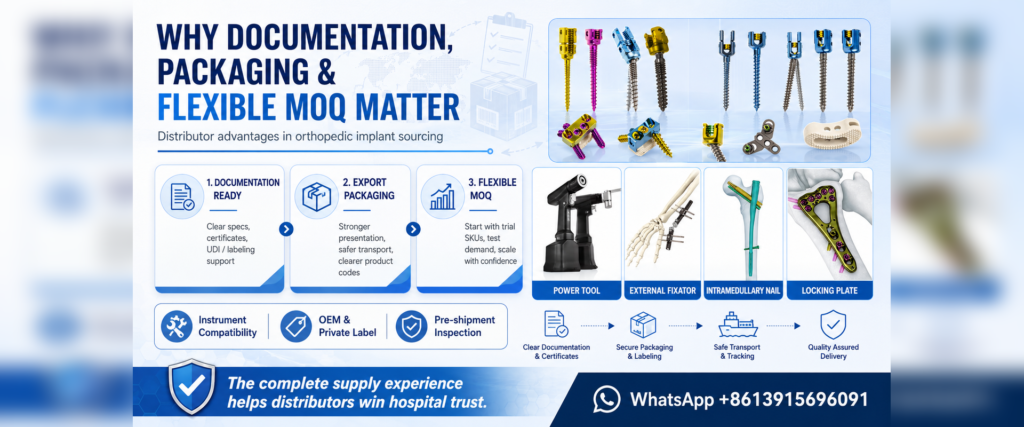
A stronger orthopedic sourcing strategy should include five practical steps.
- Build a priority SKU map.
Do not import everything at once. Identify the products most likely to create hospital demand: common trauma plates and screws, high-usage instruments, selected nails, external fixator components, or power tool options. Start with products that support repeat sales.
- Use flexible MOQ for market testing.
Small orders are not only for small buyers. They are a risk-control method. Trial orders help distributors collect surgeon and hospital feedback before committing to a larger inventory plan.
- Check documentation before the order becomes urgent.
Ask for certificates, product specifications, labeling format, packaging photos, and basic technical information early. If the supplier cannot support documents before the order, they may struggle under tender pressure.
- Evaluate supplier communication.
Fast replies are useful, but clear replies are more important. A good supplier confirms product codes, quantities, packaging, delivery timeline, and inspection details. Ambiguity creates risk.
- Connect product selection with sales strategy.
A distributor should not only ask, “What can you sell?” They should ask, “Which product line helps us enter hospitals faster and build repeat demand?”
Future Trend: Regional Distributors Will Become More Selective
In the next few years, emerging-market orthopedic distributors will likely become more selective in supplier choice. They will still care about price, but they will also compare:
- Product line completeness.
- OEM/private-label support.
- Quality consistency.
- Documentation readiness.
- Production capacity.
- Small-order flexibility.
- Delivery reliability.
- After-sales response.
This creates an opportunity for manufacturers that understand real distributor work.
For HOPE Medical, the goal is to support distributors not only with orthopedic implants and surgical instruments, but also with practical market-entry support: flexible MOQ, OEM packaging, quality inspection, and product-line suggestions for trauma, spine, external fixators, sports medicine, power tools, and basic equipment.
In a changing supply chain, the strongest distributor is not the one with the biggest catalog.
The strongest distributor is the one with the most reliable sourcing system.