

Meta Description
Discover why orthopedic distributors lose hospital opportunities despite competitive pricing. Learn practical supplier evaluation strategies, procurement risk management, documentation readiness, and orthopedic implant sourcing best practices for long-term business success.
Why Orthopedic Distributors Lose Orders Even When the Product Price Is Competitive
Everyone negotiates price.
Very few people manage risk.
That is exactly why many orthopedic distributors lose hospital contracts—even after offering competitive quotations.
Hospitals rarely reject an implant because it costs a few dollars more. They reject uncertainty. Surgeons reject inconsistency. Procurement teams reject suppliers who create operational headaches.
In today’s orthopedic market, distributors are no longer evaluated only by product cost. They are judged by whether they can guarantee smooth product registration, dependable delivery, complete documentation, technical support, and consistent product quality.
The uncomfortable truth is simple:
A cheap implant with expensive problems is never a bargain.
This article explores why distributors lose opportunities long before price becomes the deciding factor—and how choosing the right manufacturing partner dramatically reduces commercial risk.
Orthopedic Distributor Challenges Go Beyond Implant Price
Many companies still believe lowering quotations automatically increases market share.
Reality says otherwise.
An experienced orthopedic distributor understands that winning a hospital account requires much more than submitting an attractive price list. Every hospital purchasing committee evaluates risk from multiple directions. Surgeons ask whether implants are clinically reliable. Procurement departments examine documentation. Warehouse managers worry about inventory continuity. Registration teams verify certificates and technical files. Every stakeholder sees a different piece of the puzzle.
When one element fails, confidence disappears.
Instead of asking, “Who offers the lowest price?”, hospitals increasingly ask:
- Can deliveries remain stable?
- Is product documentation complete?
- Will technical questions receive fast answers?
- Can future orders be fulfilled consistently?
Those questions determine whether a distributor earns repeat business or loses credibility after a single shipment.
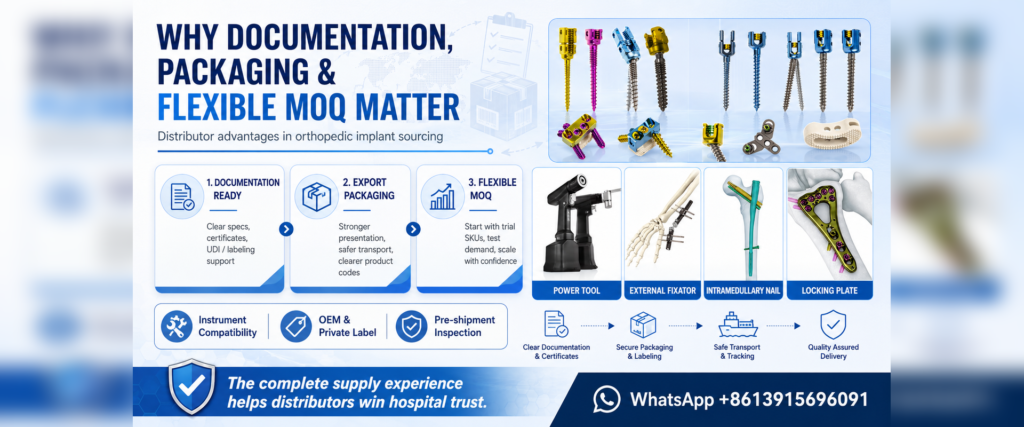
Orthopedic Implant Documentation Is a Competitive Advantage, Not Paperwork
Documentation rarely excites anyone.
Until something goes wrong.
In the orthopedic implant business, documentation functions as a commercial safety system rather than an administrative requirement. Missing specifications or incomplete certificates can delay registration, postpone tenders, or create unnecessary friction during surgeon evaluations.
Professional suppliers should provide organized technical support that includes:
- Complete product catalogs
- Material specifications
- Packaging information
- Sterilization details (when applicable)
- Inspection reports
- Product labeling guidance
- Regulatory certificates
Clear documentation also accelerates communication between distributors, hospitals, registration consultants, and purchasing departments.
Organizations such as the U.S. Food & Drug Administration (FDA) Medical Devices emphasize comprehensive technical documentation and quality management as essential parts of medical device compliance, reinforcing why documentation directly influences commercial success.
Good paperwork rarely closes a sale.
Missing paperwork often destroys one.
Reliable Orthopedic Supply Chain Management Wins More Business Than Cheap Quotes
Every distributor eventually learns one painful lesson.
Late shipments erase months of relationship building.
A delayed orthopedic supply chain affects far more than warehouse inventory. Hospitals may postpone surgeries. Surgeons lose confidence. Procurement teams begin searching for alternative suppliers. Competitors suddenly receive an opportunity they did not earn.
Reliable manufacturers openly communicate:
- Production schedules
- Quality inspection timelines
- Shipping preparation
- Export documentation
- Inventory availability
- Lead-time updates
Transparency reduces anxiety.
Silence increases it.
The strongest suppliers don’t wait until customers ask for updates—they provide them proactively. That habit alone separates strategic manufacturing partners from factories that simply process purchase orders.
Consistency, not speed, builds long-term trust.
Flexible MOQ Helps Orthopedic Distributors Test New Markets With Lower Risk
Launching an unfamiliar implant system always involves uncertainty.
Surgeons need time to evaluate products. Hospitals require internal approval. Sales representatives must build clinical confidence before purchase volume increases.
Unfortunately, some manufacturers still insist on excessive minimum order quantities (MOQ).
That creates unnecessary pressure.
Smaller trial orders allow distributors to validate several important factors before expanding cooperation:
- Packaging quality
- Product consistency
- Surgeon acceptance
- Delivery performance
- Inventory turnover
- Local market demand
A flexible MOQ is not a discount strategy.
It is a risk-management strategy.
Manufacturers who understand market development usually recognize that today’s trial order often becomes tomorrow’s long-term partnership. Rushing distributors into oversized inventory rarely accelerates growth—it often slows it down.
Quality Control in Orthopedic Manufacturing Protects Hospital Relationships
Every shipment tells a story.
One labeling mistake.
One incorrect specification.
One missing implant size.
One packaging error.
Each small issue creates consequences that extend far beyond the warehouse.
Professional quality control is not limited to manufacturing. It includes product verification before export, labeling confirmation, packaging inspection, dimensional accuracy, material traceability, and shipment review.
Experienced suppliers explain their inspection procedures confidently because they follow standardized processes rather than improvisation.
Before introducing any implant system, distributors should ask practical questions:
- How are products inspected?
- What quality records are available?
- How is traceability maintained?
- How are customer complaints handled?
- What happens if specifications require clarification?
Reliable answers reduce uncertainty before products ever reach the operating room.
Long-Term Orthopedic Supplier Relationships Depend on Communication
Communication is often underestimated because it produces no immediate invoice.
Yet poor communication quietly destroys partnerships.
Successful orthopedic supplier relationships are built through regular conversations—not emergency phone calls after problems appear.
Effective communication includes:
- Market feedback
- Product improvements
- Inventory planning
- Registration updates
- Clinical questions
- Forecast discussions
- Technical training
When manufacturers understand distributor challenges, they respond faster and make better decisions.
Likewise, distributors who share market intelligence help suppliers improve products and anticipate future demand.
Business becomes smoother because surprises become smaller.
That relationship eventually becomes a competitive advantage competitors cannot easily duplicate.
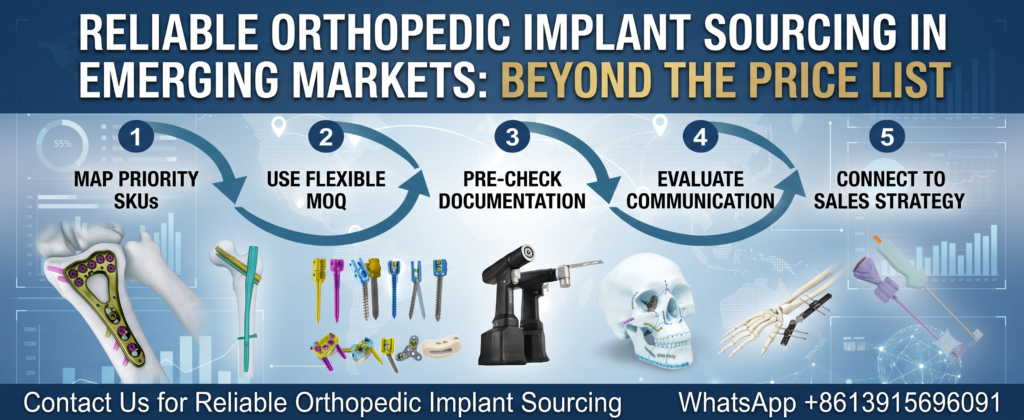
Choosing the Right Orthopedic Manufacturing Partner Reduces Procurement Risk
The best supplier is rarely the cheapest.
The best supplier removes uncertainty.
That difference changes everything.
An excellent orthopedic manufacturing partner combines competitive pricing with predictable production, transparent documentation, flexible order support, dependable quality inspection, responsive communication, and long-term cooperation.
Distributors evaluating a new implant line should ask one final question:
“Will this supplier make my business easier—or harder—one year from now?”
That question matters far more than comparing unit prices.
In today’s global medical device industry, hospitals purchase confidence as much as implants. Distributors who reduce sourcing risk, strengthen documentation, and build dependable supplier partnerships consistently outperform competitors chasing the lowest quotation.
Because in orthopedic procurement, trust compounds faster than discounts.
Key Takeaways
- Price alone rarely wins orthopedic procurement.
- Complete documentation builds buyer confidence.
- Stable delivery protects hospital relationships.
- Flexible MOQ lowers market-entry risk.
- Quality inspection prevents costly commercial mistakes.
- Strong communication creates sustainable distributor partnerships.
Discussion
What is the biggest challenge when evaluating a new orthopedic supplier?
- Price competitiveness
- Product certification
- Delivery reliability
- Technical documentation
- Quality consistency
- After-sales support
Share your experience in the comments—we’d love to hear how your market evaluates new implant partners.