

“Fracture treatment is a race between the fatigue life of the implant and the speed of bone healing.”
When you are staring at an X-ray of a broken plate or a stubborn non-union and blaming the patient’s “bad luck,” you have likely already lost the race. The brutal truth is rarely about luck. It is because we, as surgeons, violated the subtle, underlying balance between biomechanics (Stability) and Biology.
We often fall into the trap of “mechanical carpentry,” forgetting the physiological logic behind internal fixation. Today, we aren’t discussing abstract theories. Based on ICUC documentation, we are using a scalpel-sharp focus to dissect why catastrophic complications happen. We need to talk about the red lines of strain theory, strategies for anti-fatigue fixation, and the paradoxical mechanics of infection.
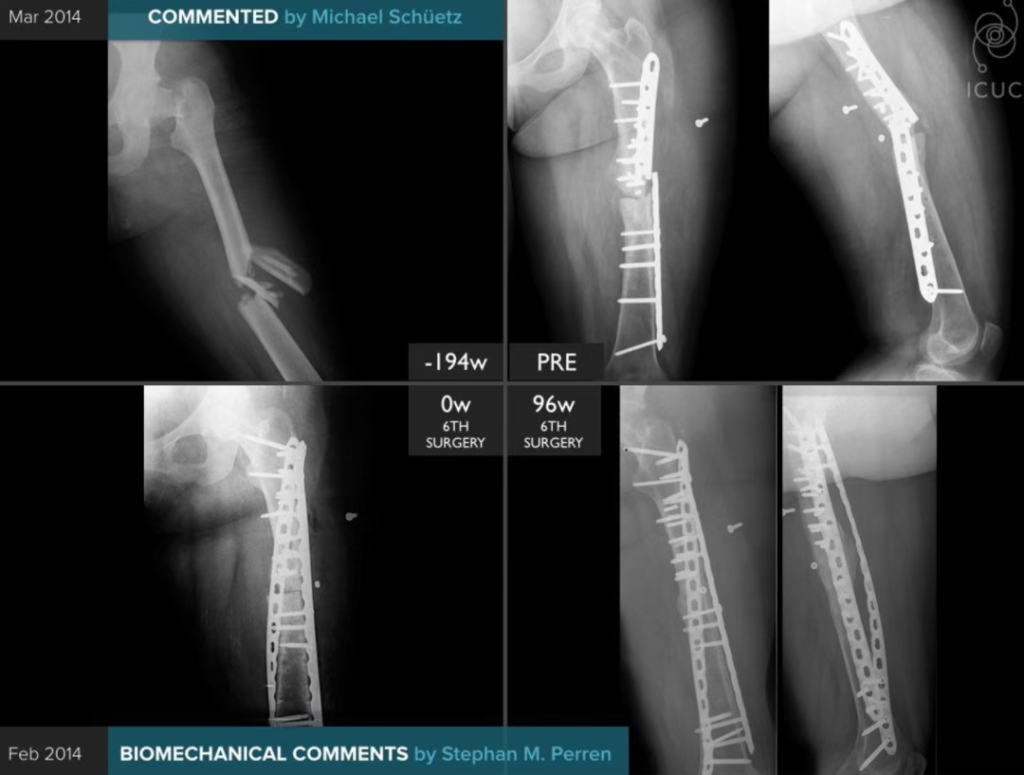
Tearing Off the Mask of Strain Theory: The Micro-Conductor of Healing
Strain Theory, proposed by Perren, might sound like dry physics, but it is the soul of the hardware you implant. Simply put, it is the ratio between the “fracture gap” and “motion.” If you don’t understand this, your locking plates are doomed to fail.
In the treatment of comminuted fractures, we usually chase relative stability with bridge plating. But there is a massive trap here:
- The Low Strain Dead End: If you use a long-span locking plate on a fracture with a huge gap but fail to allow enough micromotion, the tissue enters a “soundproof room.” It receives no mechanical signal. This leads to delayed healing or non-union.
- The High Strain Violence: Conversely, if you use flexible fixation on a simple fracture line (small gap), even tiny displacements cause >100% local strain. This effectively tears the granulation tissue apart, and the callus simply cannot bridge the gap.
The core strategy? Be precise. You must adjust the stiffness of your internal fixation construct based on the fracture pattern. Whether simple or comminuted, keep the strain environment in the “sweet spot” of 2%-10%. Only then will soft callus transform into hard bone rather than turning into useless fibrous tissue.
Implant Fatigue Failure: When Plates Become “Temporary Prosthetics”
One of the most frustrating complications is seeing a plate snap before the bone heals. In cases of long bone defects or severe comminution without medial support (like ICUC Case 32-CO-538), the traditional “Load Sharing” concept fails. Your plate is forced into “Load Bearing,” effectively acting as a suffering “temporary prosthesis.”
Simply thickening the plate? Restricting weight bearing? Don’t kid yourself. Patient compliance is often uncontrolable, and thicker plates cause stress shielding. Here, we must introduce a structural mechanics solution: the Helical Plate.
- 3D Structure Over Flat Planes: Using MIPO technology, an auxiliary pre-bent plate is slid in to complement the main lateral plate. This isn’t just “adding hardware”; it transforms a weak single-plane structure into a “box-beam” with immense resistance to bending and torsion.
- Biological Victory: It avoids extensive stripping, preserving the periosteal blood supply.
- Anti-Fatigue Core: This configuration significantly lowers peak stress on the main plate, extending fatigue life and buying time for the slow process of “creeping substitution” healing.
Want to see how the masters handle these complex cases? Check out the authoritative AO Foundation Resources or the ICUC database.
The Biomechanical Paradox of Infection: Stability is Immunity
When facing deep infection or infected non-union, the knee-jerk reaction is often: “Pull the metal out!” Wait. That reflex might doom your patient.
Biomechanics experiments have slapped this traditional notion in the face. In an infected environment, instability is a super-catalyst for bacteria. Micromotion at the fracture site creates a “pumping effect,” pushing bacteria deep into tissues while inducing bone resorption—creating the perfect dead space for bugs to hide.
- The Stability Rule: As long as the internal fixation is not loose, keep it! Absolute stability is a prerequisite for the immune system to clear bacteria.
- The War on Dead Space: Traditional DCP plates press hard against the bone, blocking blood flow and creating necrotic bone (sequesters)—a breeding ground for biofilm.
- Material Redemption: Choose Titanium whenever possbile. Compared to stainless steel, soft tissue adheres better to titanium surfaces, effectively eliminating dead space and leaving bacteria nowhere to hide. Also, solid nails beat cannulated nails—don’t give bacteria a “bunker” inside the nail.
Summary
Preventing internal fixation failure isn’t about hoping for the best. It’s about extreme command of biomechanics. From understanding the micro-mechanisms of strain to using helical plates to fight fatigue, and maintaining stability even under the threat of infection—this is the underlying logic every surgeon needs.
Disclaimer:
This article and all articles on this website are for reference only by medical professionals; specific medical problems should be treated promptly. To ensure “originality” and improve delivery efficiency, some articles on this website are AI-generated and machine-translated, which may be inappropriate or even wrong. Please refer to the original English text or leave a message if necessary. Copyright belongs to the original author. If your rights are violated, please contact the backstage to delete them. If you have any questions, please leave a message through the backstage, or leave a message below this article. Thank you!
Like and share, your hands will be left with the fragrance!
More info. https://linktr.ee/shifreeman